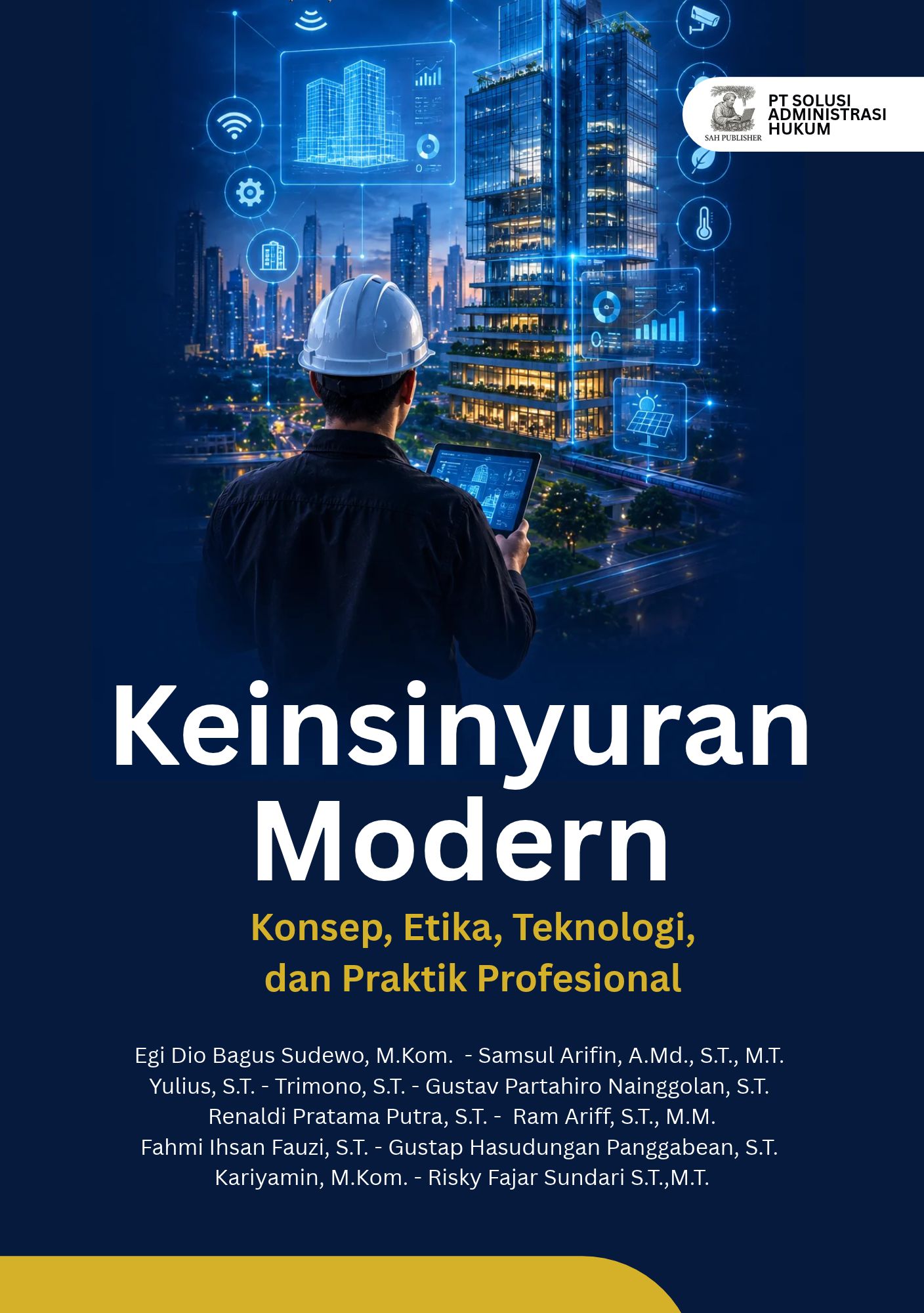
Keinsinyuran Modern: Konsep, Etika, Teknologi, dan Praktik Profesional
DOI:
https://doi.org/10.5281/zenodo.23682383Abstract
Buku Keinsinyuran Modern: Konsep, Etika, Teknologi, dan Praktik Profesional membahas landasan keinsinyuran serta perkembangannya dalam menjawab kebutuhan masyarakat, industri, dan lingkungan. Pembahasan mencakup kompetensi insinyur, tanggung jawab profesional, etika dan integritas, serta prinsip keselamatan, pengelolaan risiko, dan keandalan sistem.
Buku ini menguraikan manajemen proyek dan sumber daya, pembangunan berkelanjutan, serta pemanfaatan teknologi digital, data, otomasi, dan kecerdasan buatan dalam proses rekayasa. Perencanaan, perancangan, dan inovasi dibahas bersama penerapannya pada infrastruktur, industri, transportasi, dan sistem teknologi, dengan menekankan kolaborasi multidisiplin dan komunikasi profesional.
Dilengkapi studi kasus lintas bidang dan pembahasan tantangan masa depan, buku ini ditujukan bagi mahasiswa, calon insinyur, pendidik, dan praktisi. Buku ini diharapkan menjadi sumber pembelajaran untuk membangun kemampuan rekayasa yang adaptif, berintegritas, serta berorientasi pada keselamatan publik dan keberlanjutan.
References
Geissdoerfer, M., Savaget, P., Bocken, N. M. P., & Hultink, E. J. (2017). The circular economy—A new sustainability paradigm? Journal of Cleaner
Production, 143, 757–768. doi:10.1016/j.jclepro.2016.12.048
Ghaeb, H. O., & Mahjoob, A. M. R. (2023). Risk response in construction project: A review study. Journal of Engineering, 29(8), 121–137. doi:10.31026/j.eng.2023.08.09
Harris, C. E., Jr., Davis, M., Pritchard, M. S., & Rabins, M. J. (1996). Engineering ethics: What? Why? How? And when? Journal of Engineering Education, 85(2), 93–96. doi:10.1002/j.2168-9830.1996.tb00216.x
International Engineering Alliance. (2021). Graduate attributes and professional competencies (Version 2021.1).
International Organization for Standardization. (2018). ISO 31000:2018 risk management—Guidelines.
International Organization for Standardization. (2024). ISO 55000:2024 asset management—Vocabulary, overview and principles (2nd ed.).
International Organization for Standardization & International Electrotechnical Commission. (2023). ISO/IEC 42001:2023 information technology— Artificial intelligence—Management system.
Jardine, A. K. S., Lin, D., & Banjevic, D. (2006). A review on machinery diagnostics and prognostics implementing condition-based maintenance. Mechanical Systems and Signal Processing, 20(7), 1483–1510. doi:10.1016/j.ymssp.2005.09.012
Lemstra, M. A. M. S., & de Mesquita, M. A. (2023). Industry 4.0: A tertiary literature review. Technological Forecasting and Social Change, 186, 122204. doi:10.1016/j.techfore.2022.122204
Li, J.-P., Polovina, N., & Konur, S. (2026). A review of AI-driven engineering modelling and optimization: Methodologies, applications and future directions. Algorithms, 19(2), 93. doi:10.3390/a19020093
Llatas, C., Soust-Verdaguer, B., & Passer, A. (2020). Implementing life cycle sustainability assessment during design stages in Building Information Modelling: From systematic literature review to a methodological approach. Building and Environment, 182, 107164. doi:10.1016/j.buildenv.2020.107164
Lopez, A. (2026). Artificial intelligence applications in engineering systems: A review. International Journal of Applied and Natural Sciences, 4(1), 1–10. doi:10.61424/ijans.v4i1.691
Martin, D. A. (2026). Defining the responsibilities of engineers: A conceptual framework for engineering ethics education, policy, and practice. Engineering Studies, 18(2), 105–130. doi:10.1080/19378629.2025.2609063
Moustafa, A. M., & Mostafa, M. M. (2025). The role of life cycle assessment in sustainable product design: A state-of-the-art knowledge domain visualization. Sustainable Development, 33(6), 8907–8922. doi:10.1002/sd.70134
Nguyen, M., & Mougenot, C. (2022). A systematic review of empirical studies on multidisciplinary design collaboration: Findings, methods, and challenges. Design Studies, 81, 101120. doi:10.1016/j.destud.2022.101120
Petronijevic, J., Etienne, A., Bassetto, S., & Siadat, A. (2023). The missing link between project and product risk management: From the review to the call to action. Journal of Engineering and Technology Management, 69, 101770. doi:10.1016/j.jengtecman.2023.101770
Pilliang, M., & Munawar, M. (2022). Risk management in software development projects: A systematic literature review. Khazanah Informatika: Jurnal Ilmu Komputer dan Informatika, 8(2). doi:10.23917/khif.v8i2.17488
Project Management Institute. (2021). A guide to the project management body of knowledge (PMBOK Guide) and the standard for project management (7th ed.). Project Management Institute.
Republik Indonesia. (2014). Undang-Undang Republik Indonesia Nomor 11 Tahun 2014 tentang Keinsinyuran.
Thürer, M., Tomašević, I., Stevenson, M., Qu, T., & Huisingh, D. (2018). A systematic review of the literature on integrating sustainability into engineering curricula. Journal of Cleaner Production, 181, 608–617. doi:10.1016/j.jclepro.2017.12.130
Tribelsky, E., & Sacks, R. (2011). An empirical study of information flows in multidisciplinary civil engineering design teams using lean measures. Architectural Engineering and Design Management, 7(2), 85–101. doi:10.1080/17452007.2011.582332
United Nations. (2015). Transforming our world: The 2030 agenda for sustainable development. United Nations.
United Nations Educational, Scientific and Cultural Organization. (2021). Engineering for sustainable development: Delivering on the Sustainable Development Goals. UNESCO.
United Nations Educational, Scientific and Cultural Organization. (2022). Recommendation on the ethics of artificial intelligence. UNESCO.
World Federation of Engineering Organizations. (2023). WFEO model code of ethics. WFEO.
Yüksel, N., Börklü, H. R., Sezer, H. K., & Canyurt, O. E. (2023). Review of artificial intelligence applications in engineering design perspective. Engineering Applications of Artificial Intelligence, 118, 105697. doi:10.1016/j.engappai.2022.105697