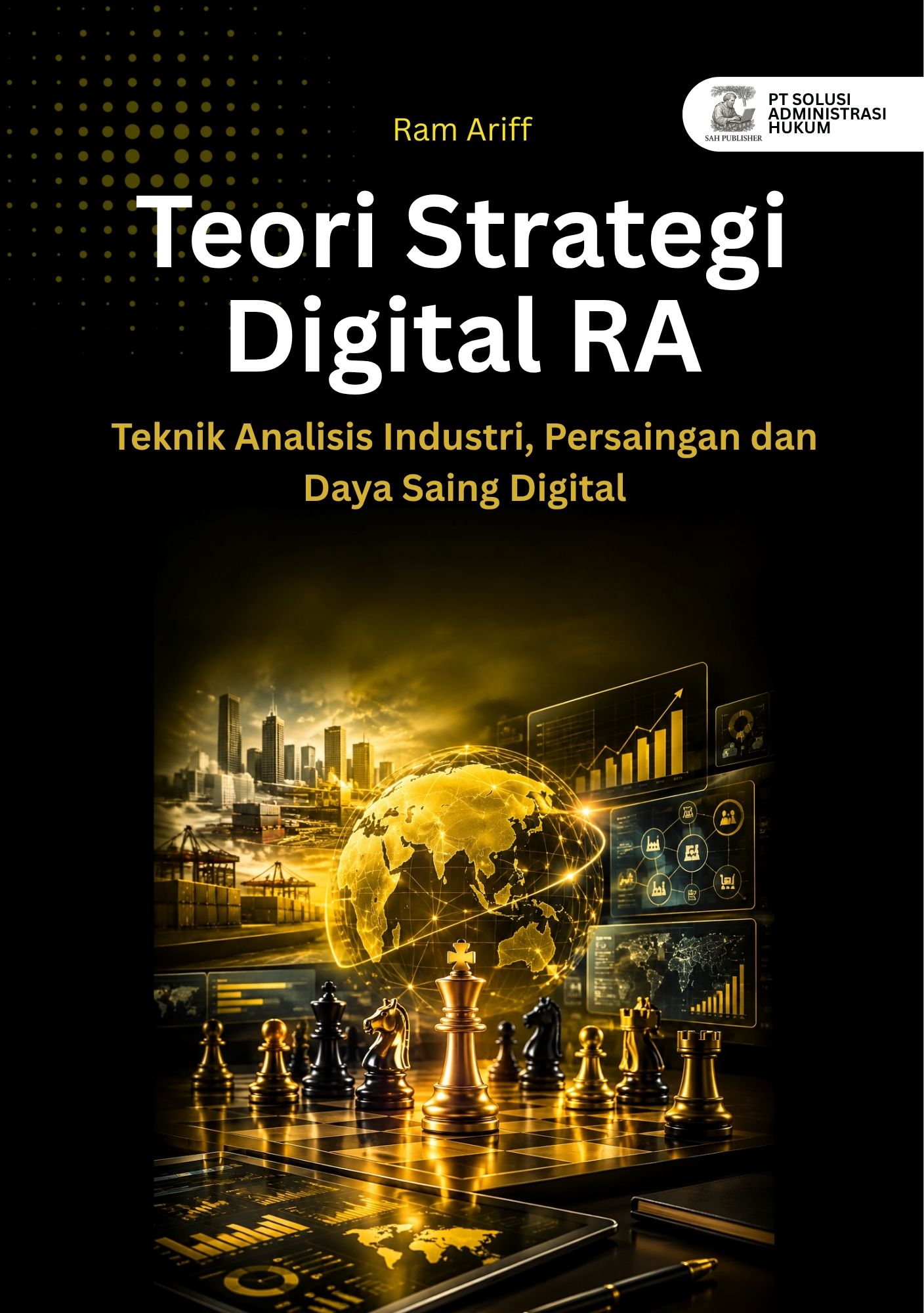
The Digital Strategy RA Theory
Techniques for Industry Analysis, Competition, and Digital Competitiveness
Abstract
Porter’s three classic frameworks—Five Forces, Generic Strategies, and the Value Chain—rely on clear industry boundaries and linear value creation. Both assumptions weaken in digital markets. This book introduces the "RA Digital Strategy Theory," which views digital advantage as a five-dimensional balance, termed L-C-A-V-E: Digital Leadership; Digital Collaboration; Digital Advantage; Digital Value; Transformation Execution. These five dimensions are measured via 20 indicators, which are aggregated using a weighted geometric mean (via the Analytic Hierarchy Process, or AHP) to produce a "Digital Strategy Value Score" expressed in "RA" units. The theory is supported by several analytical tools: The Digital Competitive Pressure Index (incorporating platform ecosystem intensity); The Cost of Imbalance; A Leverage Index for prioritizing improvements; A Digital Leadership Map; The VRIN-D test; The Digital Value Ladder; A Digital Competitive Positioning Matrix featuring four generic strategies. Simulations applied to three hypothetical organizations yielded scores of 62.48 RA for a telecommunications operator (Level 4), 35.75 RA for an MSME (micro, small, and medium-sized enterprise), and 35.15 RA for a higher education institution (Level 2). The model is further applied to four Indonesian case studies: mobile telecommunications, MSMEs, private higher education, and the banking and insurance sector. The theory is synthesized from literature spanning 2013–2026, and the book proposes six research propositions for further empirical validation. Keywords: digital strategy, digital competitiveness, digital transformation, platform ecosystem, RA Value Score, AHP.
References
Management Review, 10(6), 28–41. https://timreview.ca/sites/default/files/article_PDF/TIMReview_2020_June%20-%203.pdf
Jacobides, M. G., Cennamo, C., & Gawer, A. (2018). Towards a theory of ecosystems. Strategic Management Journal, 39(8), 2255–2276. https://doi.org/10.1002/smj.2904
Jonathan, G. M. (2023). Information technology alignment in public organisations: Towards successful digital transformation [Doctoral thesis, Stockholm University].
Kretschmer, T., Leiponen, A., Schilling, M., & Vasudeva, G. (2022). Platform ecosystems as meta-organizations: Implications for platform strategies. Strategic Management Journal, 43(3), 405–424. https://doi.org/10.1002/smj.3250
Mulyana, R. (2025). IT governance influence on digital transformation [Doctoral thesis, Stockholm University].
OECD & JRC. (2008). Handbook on constructing composite indicators: Methodology and user guide. OECD Publishing. https://doi.org/10.1787/9789264043466-en
Parker, G., Van Alstyne, M., & Jiang, X. (2017). Platform ecosystems: How developers invert the firm. MIS Quarterly, 41(1), 255–266. https://doi.org/10.25300/MISQ/2017/41.1.13
Porter, M. E. (1979). How competitive forces shape strategy. Harvard Business Review, 57(2), 137–145.
Porter, M. E. (1980). Competitive strategy: Techniques for analyzing industries and competitors. Free Press.
Porter, M. E. (1985). Competitive advantage: Creating and sustaining superior performance. Free Press.
Porter, M. E. (2008). The five competitive forces that shape strategy. Harvard Business Review, 86(1), 78–93.
Putri, E., Akbar, A. M., Alabdullah, T. T. Y., Ar-Ridho, K. J., Adhi, A. S., & Putri, W. A. A. (2025). Dynamic capability theory: Digital transformation as a sustainable competitive performance strategy for MSMEs. Riset Akuntansi dan Keuangan Indonesia, 10(3), 314–325. https://doi.org/10.23917/reaksi.v10i3.5345
Rietveld, J., & Schilling, M. A. (2021). Platform competition: A systematic and interdisciplinary review of the literature. Journal of Management, 47(6), 1528–1563. https://doi.org/10.1177/0149206320969791
Saaty, T. L. (1980). The analytic hierarchy process. McGraw-Hill.
Saaty, T. L. (2008). Decision making with the analytic hierarchy process. International Journal of Services Sciences, 1(1), 83–98. https://doi.org/10.1504/IJSSCI.2008.017590
Sani, A. (2023). Pengaruh strategi digital pada digitalisasi perguruan tinggi swasta di Indonesia dengan kemampuan digital, budaya digital, dan kolaborasi sebagai variabel mediasi [Tesis magister, Universitas Gadjah Mada]. https://etd.repository.ugm.ac.id/penelitian/detail/222219
Teece, D. J. (2007). Explicating dynamic capabilities: The nature and microfoundations of (sustainable) enterprise performance. Strategic Management Journal, 28(13), 1319–1350. https://doi.org/10.1002/smj.640
Verhoef, P. C., Broekhuizen, T., Bart, Y., Bhattacharya, A., Qi Dong, J., Fabian, N., & Haenlein, M. (2021). Digital transformation: A multidisciplinary reflection and research agenda. Journal of Business Research, 122, 889–901. https://doi.org/10.1016/j.jbusres.2019.09.022
Vial, G. (2019). Understanding digital transformation: A review and a research agenda. The Journal of Strategic Information Systems, 28(2), 118–144. https://doi.org/10.1016/j.jsis.2019.01.003
Volberda, H. W., Khanagha, S., Baden-Fuller, C., Mihalache, O. R., & Birkinshaw, J. (2021). Strategizing in a digital world: Overcoming cognitive barriers, reconfiguring routines and introducing new organizational forms. Long Range Planning, 54(5), 102110. https://doi.org/10.1016/j.lrp.2021.102110
Warner, K. S. R., & Wäger, M. (2019). Building dynamic capabilities for digital transformation: An ongoing process of strategic renewal. Long Range Planning, 52(3), 326–349. https://doi.org/10.1016/j.lrp.2018.12.001
Wessel, L., Baiyere, A., Ologeanu-Taddei, R., Cha, J., & Blegind Jensen, T. (2021). Unpacking the difference between digital transformation and IT-enabled organizational transformation. Journal of the Association for Information Systems, 22(1), 102–129. https://doi.org/10.17705/1jais.00655